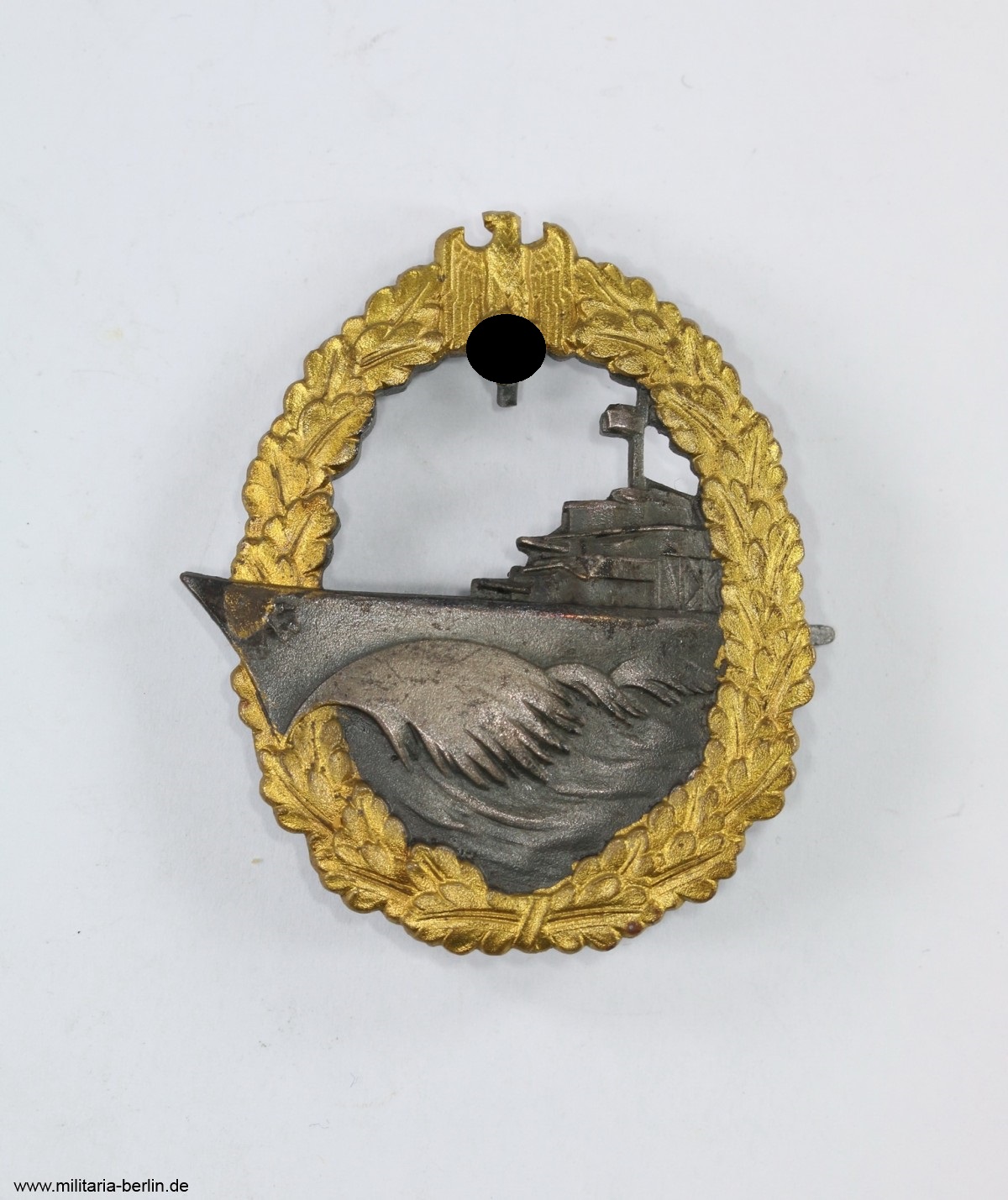
The Destroyer War Badge of the Kriegsmarine
The Destroyer War Badge was a combat badge of the German Navy during World War II. It was established on June 4, 1940, by the Commander-in-Chief of the Navy, Grand Admiral Dr. Erich Raeder. The occasion was the particularly hard and costly battles for the destroyers around Norway. A posthumous award was also possible.
Design of the Destroyer War Badge
A tall oval badge made of non-ferrous metal or tombac. From 1943 onward, it was mostly made of zinc. In the center, a destroyer moving rapidly to the left with a strong bow wave. Surrounded by a golden oak leaf wreath tied at the bottom (typical of all naval badges). In the center, at the highest point, is the Kriegsmarine's national eagle, with a swastika in its claws.
The badge was designed by Paul Casberg of Berlin. For the stylized depiction of the destroyer in the badge, Casberg used the destroyer Wilhelm Heidkamp (Z 21), which was sunk during the Battle of Narvik, as a model. The destroyer commander, Commodore Friedrich Bonte, also fell on this ship.
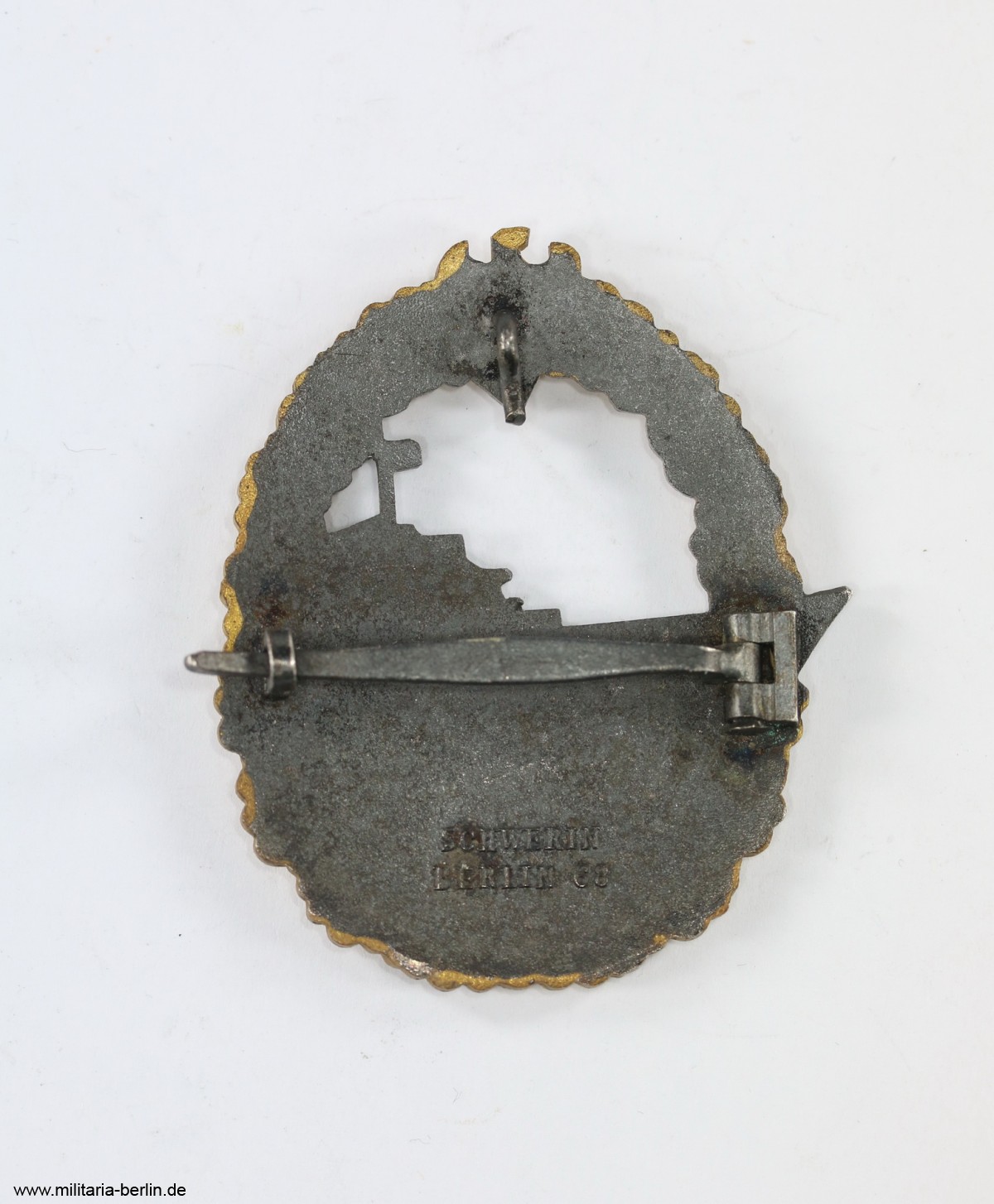
The most common manufacturer of this badge was the Schwerin Berlin company; these badges are marked on the reverse with "Schwerin Berlin68." Other manufacturers include "GWL" for Gebrüder Wegerhoff, Lüdenscheid; "JFS" for Josef Feix & Söhne, Gablonz; "L/16" for Steinhauer & Lück, Lüdenscheid; "L/18" for BH Mayer, Pforzheim; and "L/21" for Förster & Barth, Pforzheim, to name just a few. Of course, unmarked variants also exist.
Requirements for the award of the Destroyer War Badge
The award conditions for the Destroyer War Badge were issued on September 11, 1940, and were amended several times during the war. All crew members of destroyers and torpedo boats were eligible to receive the badge. Initially, until their own war badge was created, this also included the crews of fast-attack boats.
General requirements for the award were dignity and good conduct and no prison sentences had to have been imposed in the last 6 months prior to the award.
The special conditions for the award of the Destroyer War Badge were participation in at least three battles or three offensive mining operations or twelve enemy operations.
In special cases, these conditions could be deviated from, e.g. in the case of special performance, special successes, injury, or loss of the boat due to enemy action.
The destroyer crews that were deployed in the Narvik area during the occupation of Norway did not have to meet any special award conditions.
In October 1943, the special award requirements were partially amended. They now read "participation in three battles or three offensive or six defensive mine-laying operations within enemy detection zone or six enemy operations with successful results or six long-range special escort operations or twelve other operations."
Wearing the Destroyer War Badge
The Destroyer War Badge was worn as a pin-on badge on the left breast. If the wearer had also been awarded the Iron Cross 1st Class, the Destroyer War Badge had to be worn below the Iron Cross. Wearing up to two Kriegsmarine combat badges was permitted. For example, the Destroyer War Badge could be combined with the Submarine War Badge , the Fleet War Badge, the Auxiliary Cruiser War Badge , the Fast Attack Craft War Badge , the Naval Artillery War Badge , and the War Badges for Minesweeping, Submarine Hunting, and Escort Units.
The certificate for the Destroyer War Badge
A certificate bearing the signature of the unit commander and the unit's official seal was issued for the award. The award was recorded in the recipient's pay book or military service record.
Value and purchase
Due to the sheer number of different variants, a value can only be determined individually. Depending on the design, individual badges can be worth between €100 and €400. However, extensive estates, including certificates, photos, etc., can be worth well over €1.000. Individual certificates, boxes, miniatures, and photos of wearers are also of great interest to militaria collectors and are readily available for purchase.