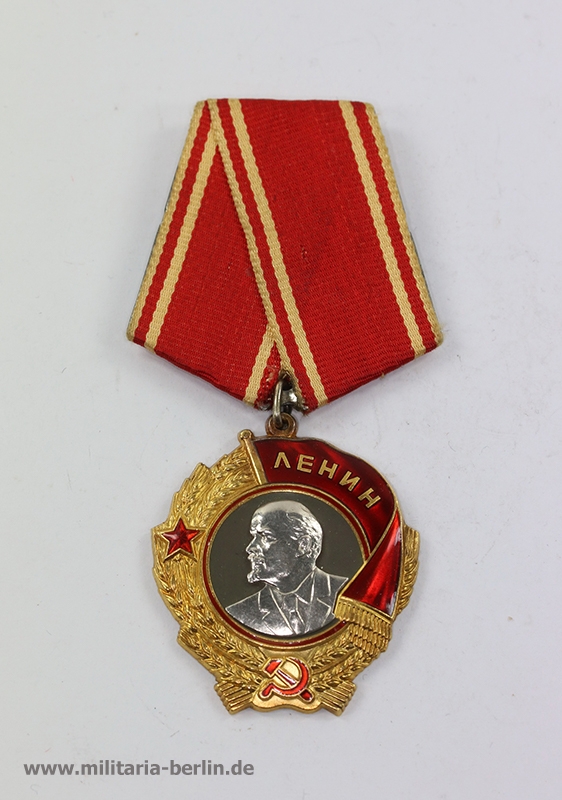
The Order of Lenin
The Order of Lenin (Russian: Орден Ленина) was established on April 6, 1930, by decree of the All-Russian Central Executive Committee. It was named after the Russian revolutionary and first leader of the Soviet Union, Vladimir Ilyich Lenin (1870–1924). Until the creation of the Order of Hero of the Soviet Union in 1934, it was the highest military and civilian decoration of the Soviet Union, and it remained a highly prestigious award even after 1934. The order was a single-class award, but multiple awards were possible; up to eleven awards to one person are known. It was awarded until 1991.
Design of the Order of Lenin
The medal's insignia is a round medallion bearing a portrait of Lenin facing left, above which floats a red enamel flag bearing the Cyrillic inscription "ЛЕНИН" (LENIN). The medallion was surrounded by a golden wreath of ears of corn, bearing a small red star on the left and the Soviet hammer and sickle symbol in the center below.
Very early, extremely rare variants depict Lenin in front of an industrial plant with chimneys and a tractor in the foreground; the symbols in the wreath of ears of corn are also distributed differently. These early, rare pieces are also known as "Tractor Lenin."
The early orders were worn as pin-on medals with a screw disc on the reverse, while the later ones were worn on a pentagonal clasp. The ribbon is red with double gold border stripes on both sides. The medallion is gold, and the Lenin portrait is platinum. The reverse bears the award number, which in most cases also identifies the wearer. The reverse also bears the maker's name, usually either the Leningrad State Mint or the Moscow State Mint. The award is approximately 44 mm high and 40 mm wide, and weighs approximately 33 g (without lanyard and ring). The manufacture and workmanship of the order itself are of very high quality; the clasp and ribbon often appear simple.
Prerequisite for the award of the Order of Lenin
The Order of Lenin could be awarded to citizens of the Soviet Union and foreign nationals. The following requirements were met for the award:
- Officials for outstanding services to the state or party (CPSU)
- Workers, for outstanding work performance or exceeding the target
- Soldiers of the Red Army, for exemplary service and bravery at the front
- Foreign citizens, for services to international friendship and peace, or for outstanding services to Soviet society or the state
Recipients of the Hero of the Soviet Union and Hero of Socialist Labor (Hero of Labor) awards were automatically awarded the Order of Lenin.
As a special feature, the order could also be awarded to factories, cities, or regions.
Wearing the Order of Lenin
The Order of Lenin was worn on the left side of the chest, first on the large order bar. The higher-ranking Order of Hero of the Soviet Union was worn separately above the order bar. If the recipient was a multiple recipient of the Order of Lenin, all orders were worn consecutively.
Award figures for the Order of Lenin
A total of approximately 600.000 copies were awarded by 1991. During World War II, approximately 36.000 copies were awarded to members of the Red Army and its allies.
Value and purchase of an Order of Lenin
Due to the sheer number of different variants, a value can only be determined individually. The value of the piece depends heavily on the individual award number on the back, as this can be used to identify the wearer or at least narrow down the award period. Due to the precious metal used, the value of an Order of Lenin also depends heavily on the current gold or platinum price. However, for a flawless piece, you can expect a price starting at €1.000.