The Crimean Shield
The Crimean Shield was a German combat badge designed as a sleeve shield during World War II. Army Group South conquered the Crimean peninsula between autumn 1941 and summer 1942. After the fighting ended and the capture of the fortress of Sevastopol, the Crimean Shield was established by Adolf Hitler on July 25, 1942.
The design of the Crimean shield
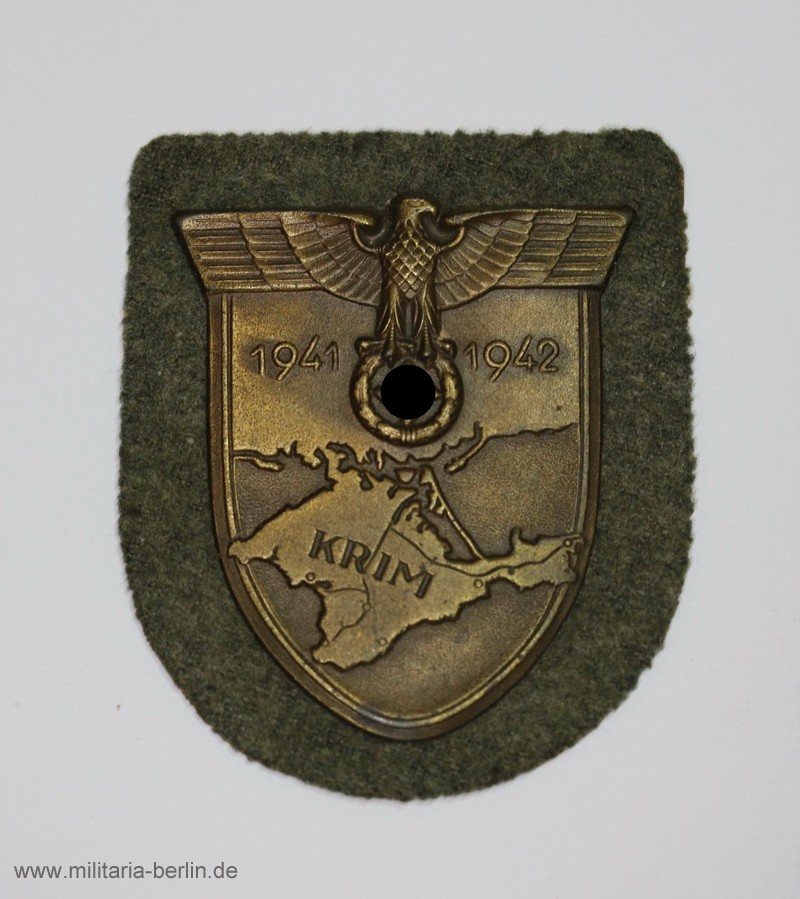
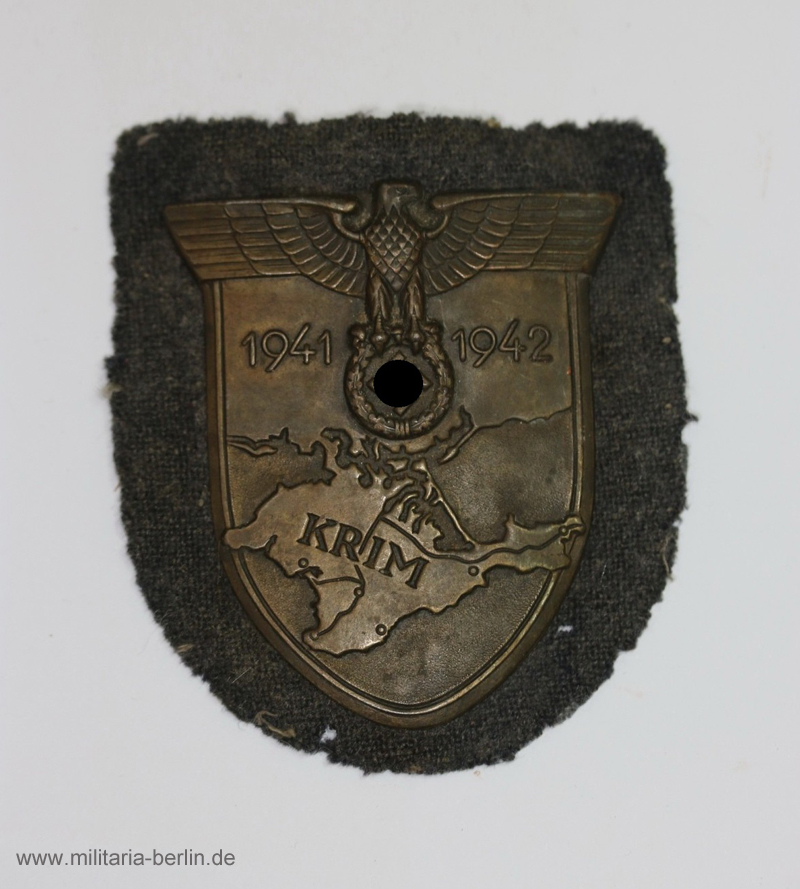
A sheet metal shield (usually made of iron, but also zinc) punched out in the typical shape of a coat of arms. The bronzed shield features the imperial eagle with a swastika in its claws at the top. Below the eagle's wings, the years "1941" and "1942" are inscribed. The main part of the shield is a map of the Crimean peninsula, bearing the inscription "Crimea."
The conditions for awarding the Crimean Shield
The Crimean Shield could be awarded to all members of the Wehrmacht or those subordinate to the Wehrmacht High Command who honorably participated in the fighting for Crimea on land, at sea, and in the air from September 21, 1941, to July 4, 1942. This also included the Romanian allies participating in the fighting in Crimea.
Award numbers of the Crimean Shield
Unfortunately, the exact figures are unknown today. However, it is estimated that approximately 300.000 awards were made. Each recipient generally received several copies, a separate shield for each uniform. Field Marshal Erich von Mannstein, the German commander of the troops in Crimea, and Romanian Marshal Ian Antonescu were each awarded a golden Crimean Shield as a special honor.
Wearing the Crimean shield
The Crimea shield, like all Wehrmacht sleeve shields, was worn on the left upper arm of the uniform. The shield was backed with a cloth in the uniform color, e.g., gray-green for the Army, blue-gray for the Air Force, black for the special uniforms of tank crews, etc. This cloth backing was then sewn to the uniform itself. Wearing multiple sleeve shields, e.g., the Narvik shield , Kholm shield , Kuban shield , or Demyansk shield , was possible. However, special rules applied to this.
Value and purchase
Due to the large variety of different versions, a value can only be determined individually. Generally, however, you can expect to pay around €100 for a single shield in good condition. However, for extensive estates, e.g., including certificates, photos of wearers, uniforms, etc., the value can easily exceed €1.000.