The Auxiliary Cruiser War Badge
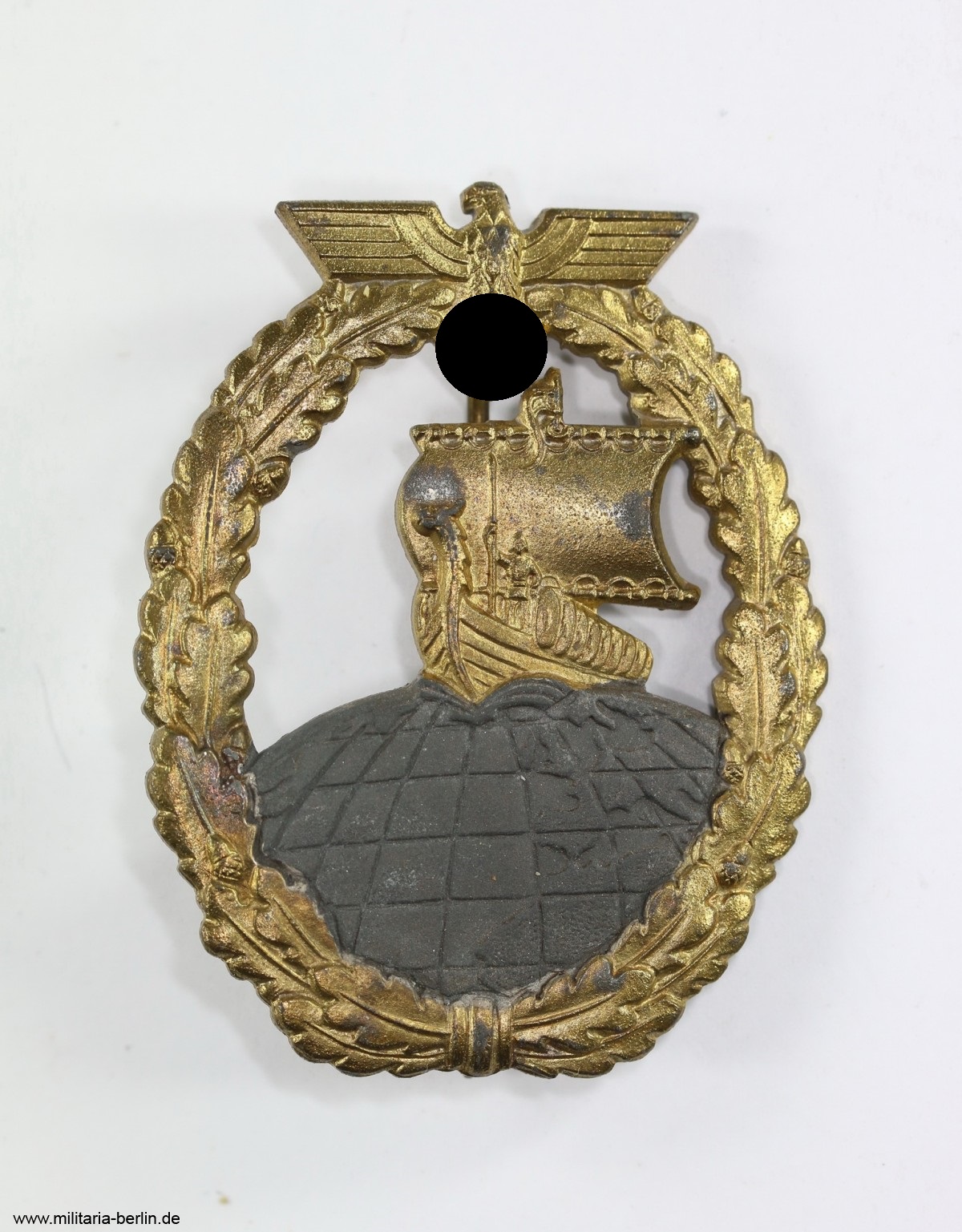
The Auxiliary Cruiser War Badge was a combat badge of the German Navy during World War II. It was established on April 24, 1941, by the Commander-in-Chief of the Navy, Grand Admiral Dr. Erich Raeder. It could be awarded to all crew members of auxiliary cruisers deployed in cruiser warfare. Posthumous award was also possible.
A special version with a diamond-studded swastika is known. However, this is not an official decoration of the Kriegsmarine, but rather an honorary award from the Commander-in-Chief of the Kriegsmarine to specifically honor exceptional services. Two known recipients of this badge are Captain Bernd Rogge and Captain Hellmuth von Ruckteschell. Both were distinguished commanders of auxiliary cruisers.
Design of the Fleet War Badge
A tall oval badge made of non-ferrous metal or zinc, in some special cases also of silver (sterling silver). A separately applied globe is placed in the center. Atop the globe is a stylized Viking ship with its sails set, sailing to the left. Surrounded by a golden oak leaf wreath tied at the bottom (typical of all naval badges). In the center, at the highest point, is the naval eagle, with a swastika in its claws.
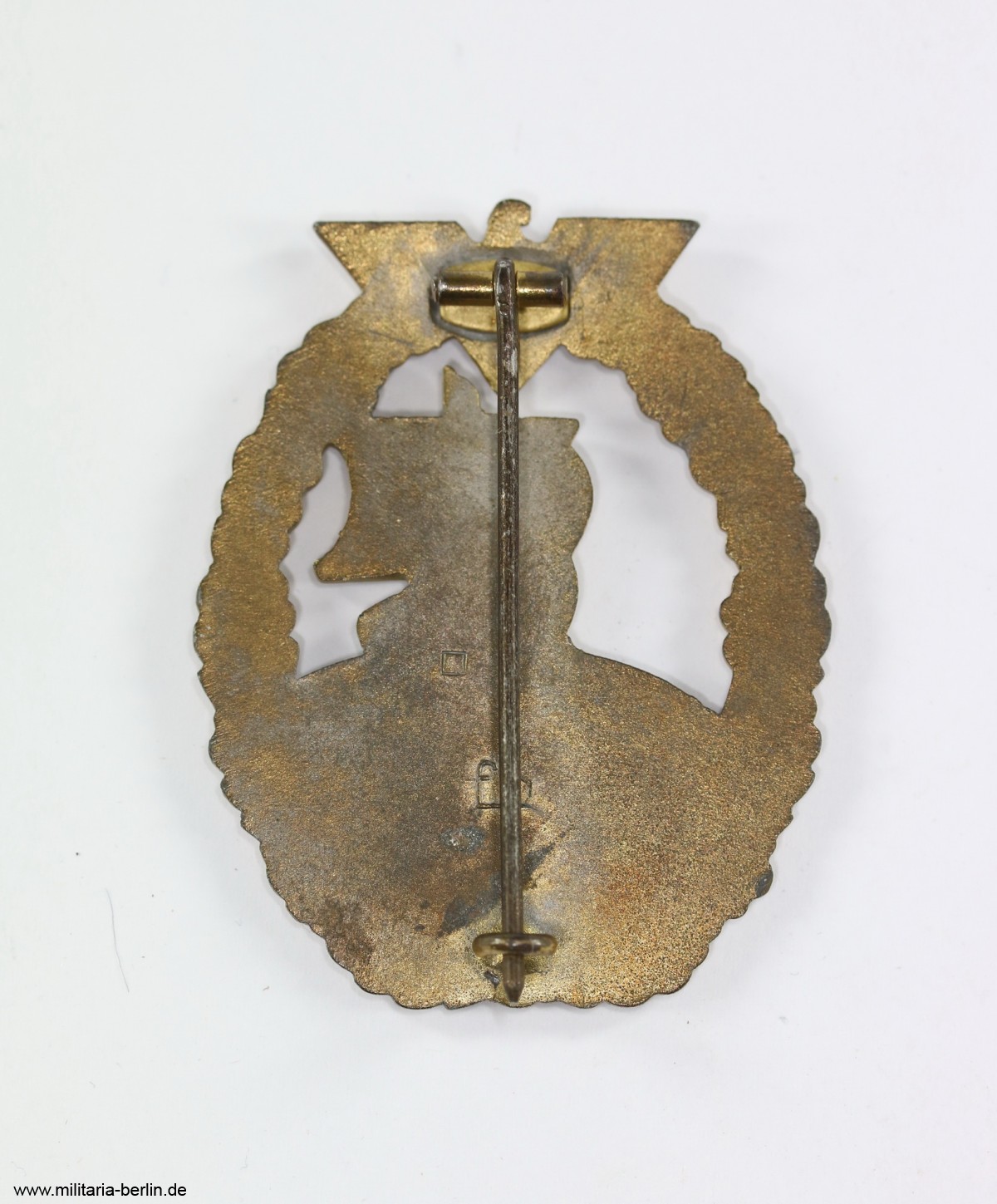
The most common manufacturer of this badge was the company Schwerin Berlin; these badges are marked on the back with “Schwerin Berlin”.
Requirements for the award
Crew member on an auxiliary cruiser. Dignity and impeccable conduct, as well as participation in at least one operational cruise on an auxiliary cruiser. The badge was awarded by the commander of the respective ship. The badge was designed by Wilhelm Peekhaus.
Crew members of the following ships could be awarded the Auxiliary Cruiser War Badge:
Orion, Atlantis, Aries, Thor, Penguin, Taurus, Comet, Cormorant, Michel, Coronel and Hansa.
Wearing the Auxiliary Cruiser War Badge
The Auxiliary Cruiser War Badge was worn as a pin-on badge on the left breast. If the wearer had also been awarded the Iron Cross 1st Class, the Auxiliary Cruiser War Badge had to be worn below the Iron Cross. Wearing up to two Kriegsmarine combat badges was permitted. For example, the Auxiliary Cruiser War Badge could be combined with the Submarine War Badge , the Destroyer War Badge, the Fleet War Badge , the Fast Attack Craft War Badge , the Naval Artillery War Badge , and the War Badges for Minesweeping, Submarine Hunting, and Escort Units.
The certificate
A certificate bearing the signature of the unit commander and the unit's official seal was issued for the award. The award was recorded in the recipient's pay book or military service record.
Value and purchase
Due to the multitude of different variants, a value can only be determined individually. Individual badges can be worth between €350 and €1.200, depending on the design. Extensive estates, including certificates, photos, etc., can be worth over €10.000. Individual certificates, boxes, miniatures, and photos of the wearer are also of great interest to militaria collectors. The subject of auxiliary cruisers is one of the most popular in the naval field and is always highly sought after.