Royal House Order of Hohenzollern
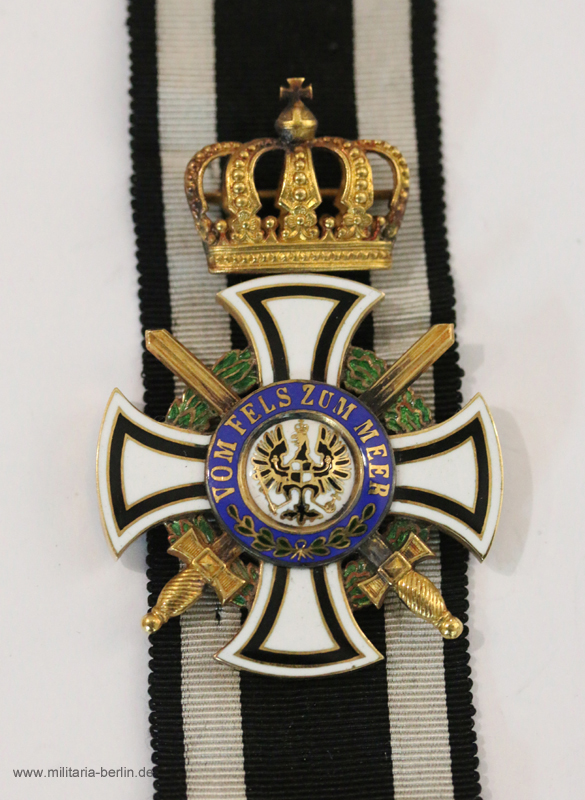
The House Order of Hohenzollern was established in three classes on December 5, 1841, by Prince Konstantin of Hohenzollern-Hechingen and Prince Karl Anton of Hohenzollern-Sigmaringen. After the two principalities passed to Prussia in 1850, the initially princely House Order of Hohenzollern was finally elevated to the Royal House Order of Hohenzollern on January 16, 1851, by the Prussian King Frederick William IV.
Who could be awarded the House Order of Hohenzollern
The manufactory's program included both art objects such as porcelain animal figurines and wartime ...
An important function of the manufactory was to produce "city and state gifts." Then as now, it was in keeping with international custom to present art porcelain to state guests visiting Germany and their accompanying diplomatic corps.
The classes of the House Order of Hohenzollern
There are a wide variety of different levels and attributes of the Royal House Order of Hohenzollern. Unfortunately, it is not possible to list them all here, especially since they have changed several times over the long period of awarding.
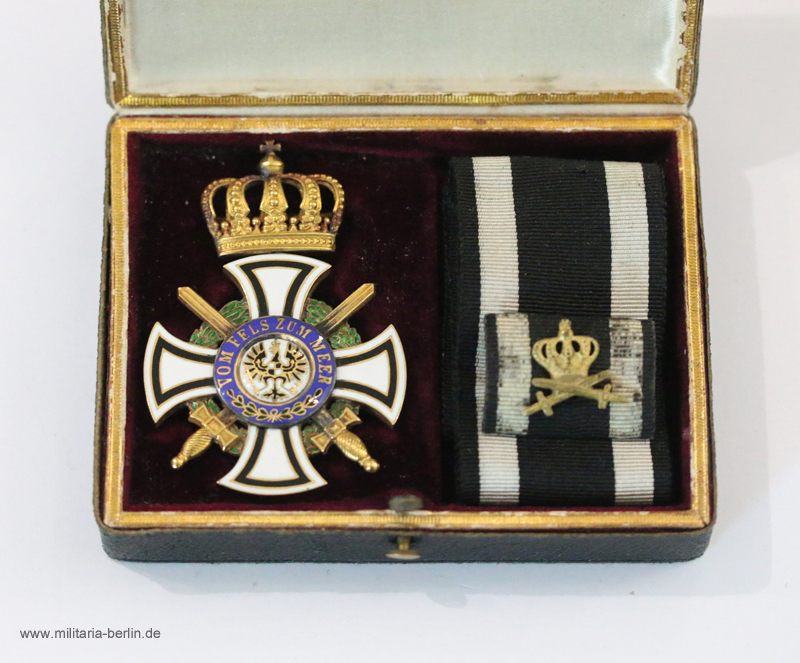
The most well-known and common are certainly the Knight's Cross with Swords, awarded for military merit from 1866 to 1918, and the Bearer's Eagle, awarded for civilian merit.
The Knights Cross with Swords of the Royal House Order of Hohenzollern can be considered a gallantry decoration positioned between the Iron Cross 1st Class and the Pour le Mérite . In a sense, it represents a precursor to the German Cross in World War II.
Value and purchase of a House Order of Hohenzollern
Due to the sheer number of different variants, a value can only be determined individually. Large estates, including documents, photos, etc., can sometimes be worth well over €10.000. However, individual crosses or documents are also very interesting for collectors and command a correspondingly high price.