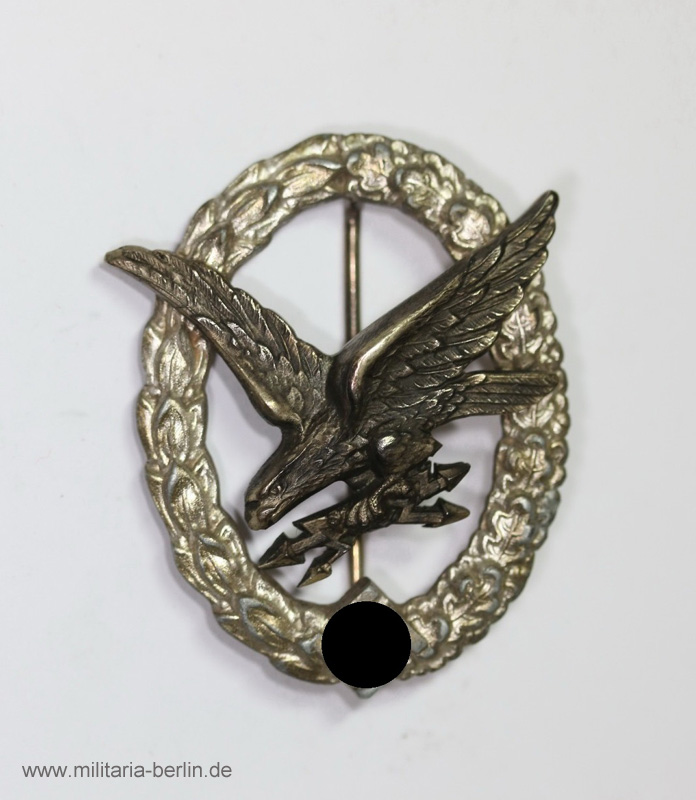
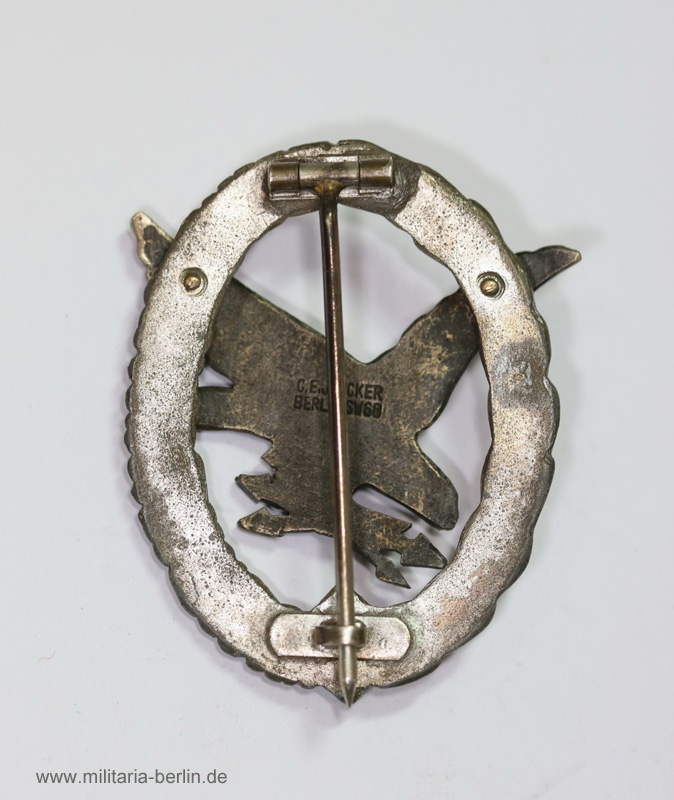
The Luftwaffe's aviator gunner's badge
The badge was established in Berlin on March 26, 1936, by the Reich Minister of Aviation and Commander-in-Chief of the Luftwaffe, Hermann Göring. It is also known as the Air Radio Operator Badge or Air Mechanic Badge and was one of the German Air Force's activity badges during World War II. Therefore, the Air Gunner's Badge is not a decoration in the true sense of the word.
Design of the Air Gunner Badge
Oval badge made of non-ferrous metal or zinc, in rare cases also of aluminum. The wreath is formed of oak leaves and laurel, each half of the wreath. At the bottom of the wreath is the swastika as the national emblem. Above it is a detailed eagle, facing slightly to the left. The eagle is riveted to the wreath. The wreath is silver-plated, the eagle blackened. In exceptional cases also with a silver-plated eagle. Typical manufacturers were CE Juncker, Berlin (CEJ); Jimme & Sohn, Berlin; Wilhelm Deumer, Lüdenscheid; Assmann & Sohn, Lüdenscheid (A); Berg & Nolte, Lüdenscheid (B&NL) and the Schneider Brothers AG, Vienna (BSW).
Requirements for the award of the Air Gunner Badge
The badge was awarded exclusively to Luftwaffe aircrew. Eligible for award were radio operators, flight mechanics, and gunners who had completed their relevant training, but no earlier than one year after the start of basic training. However, this practice was changed during the war. The badge could now be awarded after as few as five combat missions or two months of continuous service. As a special feature, it was also possible to award it immediately after being wounded during a combat mission.
Award numbers of the Air Gunner's Badge
Unfortunately, there are no detailed information or figures available today regarding the number of awards for the Air Gunner's Badge. However, it can be assumed that approximately 60.000 were awarded between 1936 and 1945.
How to wear the Air Gunner Badge
The Air Gunner's Badge was worn as a pin-on badge on the right breast. If the wearer had also been awarded the Iron Cross 1st Class , the Air Gunner's Badge had to be worn below the Iron Cross. If the wearer later trained as a pilot or observer, the Air Gunner's Badge had to be removed and the Pilot's Badge or Observer's Badge worn.
The certificate for the Air Gunner Badge
A certificate of award was issued. Furthermore, the award was recorded in the recipient's pay book and military service record.
Value and purchase of an aviation gunner's badge
Due to the sheer variety of variations, a value can only be determined individually. Individual badges, depending on the design, can range in price from €250 to €1.000. Entire estates, including certificates, photos, uniforms, etc., can sometimes be worth well over €3.000. However, individual certificates, documents, and cases are also of interest to militaria collectors.