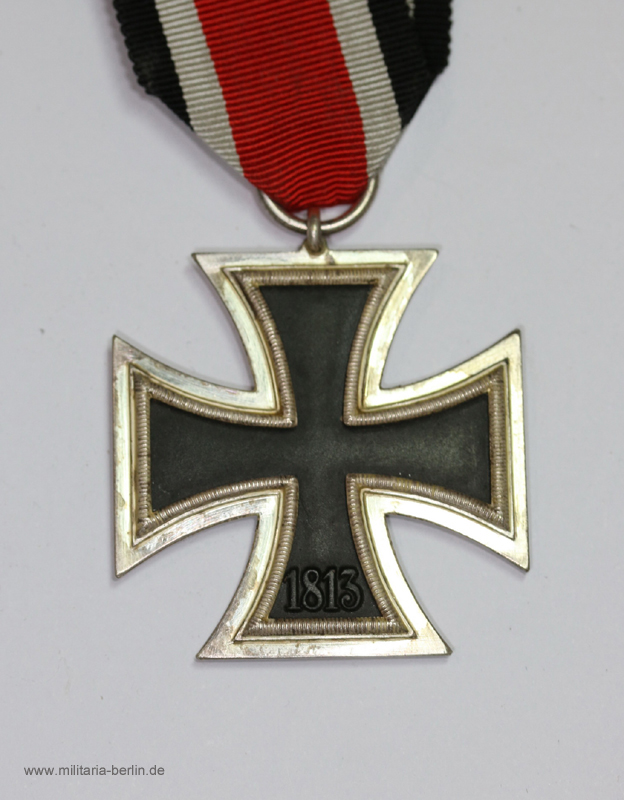
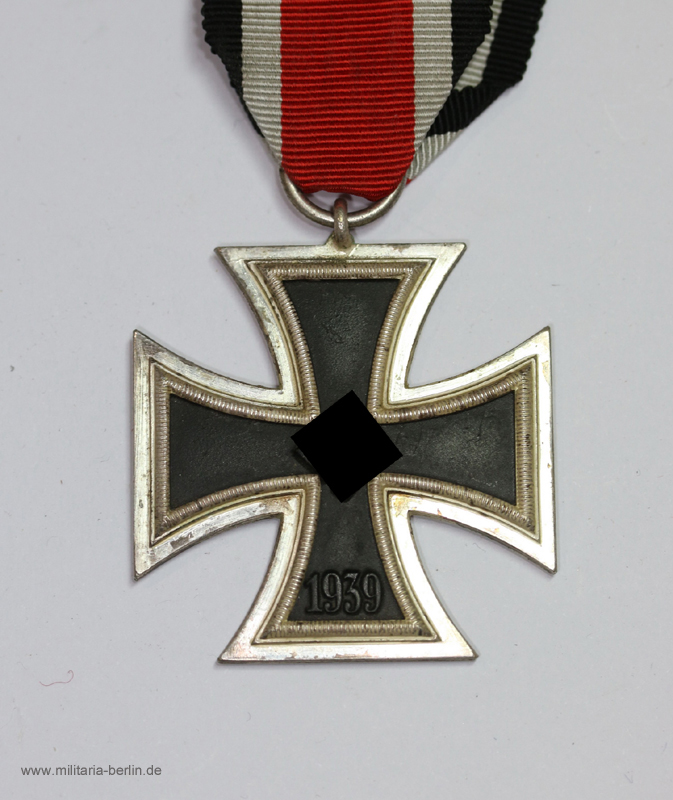
The Iron Cross
– Iron Cross 1st Class Iron Cross 1813-1957
– Iron Cross 2nd Class (Iron Cross until 1918)
– Grand Cross of the Iron Cross (Iron Cross from 1933)
– Knight's Cross of the Iron Cross
The Iron Cross was originally a Prussian, later a German, war decoration. It was first instituted on March 10, 1813, by King Frederick William III of Prussia for the course of the Wars of Liberation.
King William I of Prussia renewed the establishment of the Iron Cross with the outbreak of the Franco-Prussian War on July 19, 1870. Emperor William II renewed the establishment on August 8, 1914, for the First World War, thus making the Iron Cross a German award, at least in terms of awarding practice.
With the fourth foundation at the beginning of the Second World War on September 1, 1939 by Adolf Hitler, the Iron Cross officially became a German award.
Design of the Iron Cross
Based on a personal drawing by King Frederick William III of Prussia, the architect Friedrich Schinkel designed an Iron Cross. The king specified that the order "should consist of a black, cast-iron cross framed in silver."
The material of the Iron Cross, iron, was symbolic. Unlike most other orders of the period, the Iron Cross deliberately avoided precious materials. The simple cast iron of an iron cross represented the chivalric devotion to duty and restraint of the Prussian soldiers. It was also a reference to the Iron Age of ancient mythology. It was also consciously linked to the patriotic song of the poet Ernst Moritz Arndt, which begins with the words: "The God who made iron grow, he wanted no servants..."
The shape of the new decoration was also deliberately based on the Balkenkreuz of the Teutonic Order: a black cross with widening ends. This was intended to place the War of Liberation against Napoleon in the tradition of the Crusades.
To whom could an Iron Cross be awarded
With the Iron Cross, King Frederick William III established the first German decoration ever that could be awarded without regard to social class, origin, or military rank. This was revolutionary for the time. The only prerequisite for the award of an Iron Cross was outstanding action during the War of Liberation. Class distinctions no longer matter!
The classes of an Iron Cross
The Iron Cross was originally awarded in three classes. Further grades of the Iron Cross (e.g., the Knight's Cross ) were added only during World War II. The lowest grade was the Iron Cross 2nd Class, the next grade the Iron Cross 1st Class . The highest grade was the Grand Cross of the Iron Cross.
New Foundation of the Iron Cross 1870/71
With the outbreak of the Franco-Prussian War, the Iron Cross was renewed by King William I of Prussia. It could now be awarded not only to Prussians, but to all citizens of the German federal states.
The obverse of an Iron Cross now featured the royal monogram "W" for King Wilhelm in the center, with the year of its foundation, "1870," below it. On August 18, 1895, on the occasion of the 25th anniversary of the victory over France, Emperor Wilhelm II established a silver foliage consisting of three oak leaves bearing the anniversary number 25, which was to be worn on the ribbon of the Iron Cross 2nd Class.
New Foundation of the Iron Cross 1914
With the outbreak of World War I, the Iron Cross was reinstated (August 8, 1914). The obverse of the Iron Cross again featured the imperial monogram "W" in the center, this time for Kaiser Wilhelm II, and below it the year of its foundation, "1914." Recipients of the Iron Cross from 1870 who were again awarded an Iron Cross received a silver clasp with a reduced EK bearing the year 1914 (repeat clasp), to be worn on the ribbon of the Iron Cross 2nd Class, above the silver oak leaves (for the 25th anniversary of the victory).
New Foundation of the Iron Cross 1939
The last Iron Cross was established at the outbreak of World War II on September 1, 1939. The obverse of the Iron Cross now featured a swastika in the center, with the year of its establishment, "1939," below it. The Iron Cross was also expanded to include additional degrees. Thus, the Knight's Cross of the Iron Cross was established right at the beginning of World War II. It ranked higher than the Iron Cross 1st Class and was expanded over the course of the war with additional degrees: Oak Leaves for the Knight's Cross of the Iron Cross, Oak Leaves and Swords for the Knight's Cross of the Iron Cross, Oak Leaves with Swords and Diamonds for the Knight's Cross of the Iron Cross, and Golden Oak Leaves with Swords and Diamonds for the Knight's Cross of the Iron Cross. However, the highest degree of the Iron Cross remained the Grand Cross of the Iron Cross.
Even in World War II, recipients of the Iron Cross of 1914 did not receive another Iron Cross when awarded again, but rather a repeat clasp, which was to be worn on the ribbon (2nd Class) or directly above the Iron Cross 1st Class (1st Class).
Value and purchase of an Iron Cross
Due to the large number of different grades and variants, a value can only be determined individually. Large estates at the higher grades, such as the Knight's Cross and Grand Cross, can sometimes be worth several hundred thousand euros. However, individual lower grades can also be very interesting for collectors and command a correspondingly high price.