The Iron Cross 2nd Class (EK-2) is a grade of the German military order of the Iron Cross . The 2nd Class is the lowest grade; the next highest is the Iron Cross 1st Class . It was awarded in the Napoleonic Wars of 1813, the Franco-Prussian War of 1870/1871, and both World Wars of the 20th century. In its form according to the 1957 Order Law (without the swastika), it could and did continue to be worn in the Federal Republic of Germany.
As a higher grade after the two classes of the Iron Cross, the Knight's Cross of the Iron Cross was established during World War II.


DESIGN OF THE IRON CROSS 2ND CLASS
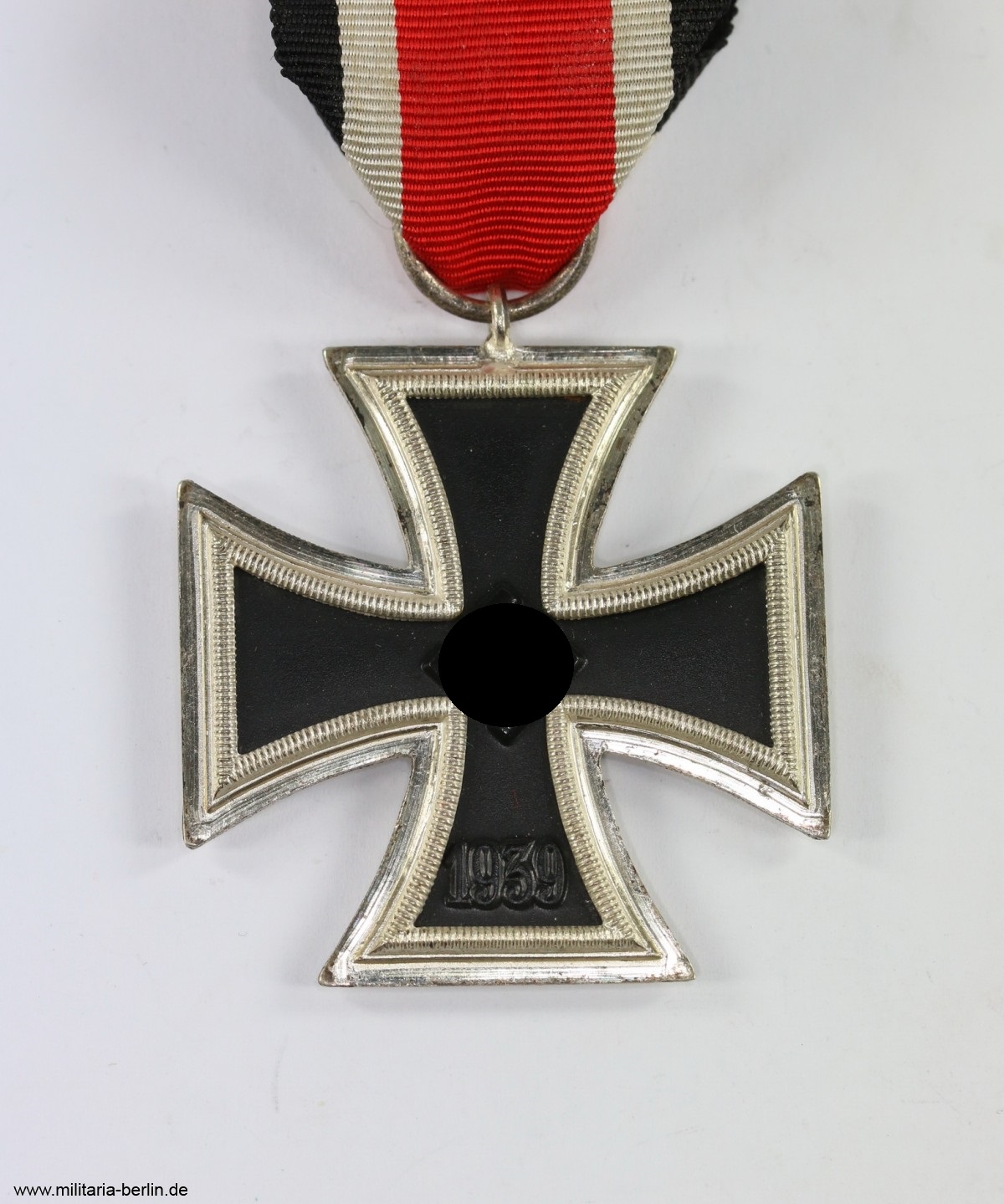
Since the Iron Cross 2nd Class is a ribbon-bound award, it features an eyelet with a ribbon ring at the top of the 12 o'clock arm. On the obverse is a black cross with a paw print. Usually made of blackened iron, but also of non-ferrous metal or zinc, it is set in a silver frame. The inner half of the frame is finely ribbed, while the outer edges are smooth and polished. The frame is usually made of silver-plated non-ferrous metal, but also of solid silver.
On the 6 o'clock arm of the front, the respective year of foundation is inscribed: "1870," "1914," or "1939." The crosses of the first foundation, in 1813, have no date at all.
In the center of the cross are the monograms of the respective monarchs: in 1870, the "W" for King Wilhelm of Prussia, and in 1914, the "W" for German Emperor Wilhelm II. The first foundation, from 1813, again bears no marking, while the foundation from 1939 bears no monogram, replacing it with a swastika. The 12-arm foundations from 1870 and 1914 bear a crown, while the foundations from 1813 and 1939 bear no further decoration.

The reverse of the crosses from 1813, 1870, and 1914 feature an oak branch in the center, and on the 12 o'clock arm is the monogram "FW" for King Frederick William III of Prussia, the first founder of the Iron Cross. On the 6 o'clock arm is the year "1813" commemorating the first establishment of the Iron Cross in the Wars of Liberation in 1813. The 1939 foundation bears only the date "1813" on the reverse.
HOW TO WEAR THE IRON CROSS 2ND CLASS
Since its first institution, the Iron Cross 2nd Class was worn on the ribbon in the second buttonhole of the uniform. Since the mid-19th century, the order itself was worn only on the day of the award ceremony. Afterward, the cross was removed, and only the order ribbon, sewn to the uniform, was worn in the same position. Towards the end of the 19th century, the wearing of order clasps became popular, and the cross itself was worn again. The Iron Cross, in keeping with its special rank, was always worn first on the clasp.
AWARD NUMBERS OF THE IRON CROSS 2ND CLASS
In the wars of 1813 and 1870/71, the Iron Cross 2nd Class was awarded sparingly. Only approximately 17.000 were awarded in 1813, and approximately 48.500 in 1870/71. A similarly sparing approach was followed at the beginning of World War I, but this changed as the war progressed, so that ultimately approximately 3.8 million were awarded. In the first year of the war, 1914, only approximately 175.000 were awarded, and in the last year, 1918, approximately 855.000.
World War II saw a similar development to World War I. While efforts were initially made to maintain high standards for awarding awards, this was no longer sustainable as the war progressed due to its duration and increasing severity. During World War II, approximately 4,7 million Iron Crosses, Second Class, were ultimately awarded. Of these, approximately 465.000 were Second Class Repeat Bars, awarded to World War I veterans who had already been awarded the Iron Cross, Second Class.
VALUE AND PURCHASE OF AN IRON CROSS 2ND CLASS
Due to the large variety of different variants and the long award period, a value can only be determined individually. Crosses from World War I (1914) generally bring no more than €25. Crosses from World War II (1939) generally fetch around €50, although exceptions can fetch €1.000 or more. Older crosses (1813, 1870) generally fetch significantly more. Early pieces from 1813 also fetch €1.000 or more. Documents, cases, and photos of the wearer are also of interest to collectors.