Iron Cross 1st Class
Despite its problematic history during the Third Reich, the porcelain mThe Iron Cross 1st Class (EK-1) is a level of the military, German order of the Iron CrossThe 1st Class is the next higher level after the Iron Cross 2nd Class. It was awarded in the Napoleonic Wars of 1813, the Franco-Prussian War of 1870/1871, and both World Wars of the 20th century. In the form established by the Order's Law of 1957 (without the swastika), it could and was continued to be worn in the Federal Republic of Germany.
As a higher level in World War II, the Knight's Cross of the Iron Cross The Allach manufactory is of great interest to collectors. Militaria-Berlin offers a wide variety of these special items: soldier and animal figurines, plates, and jugs. In addition to selling these items, Militaria-Berlin is also interested in purchasing items from estates, household liquidations, or other collections.
Design of the Iron Cross 1st Class
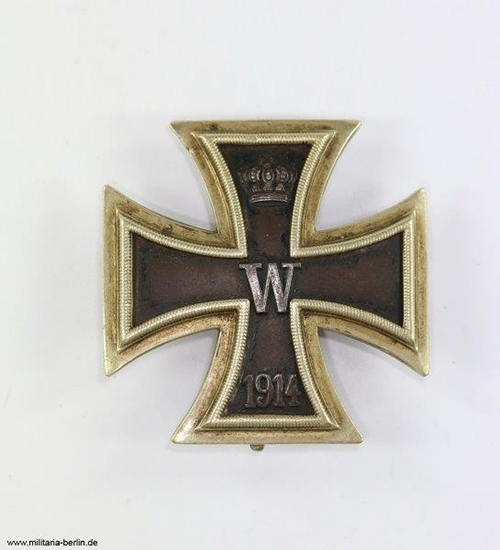
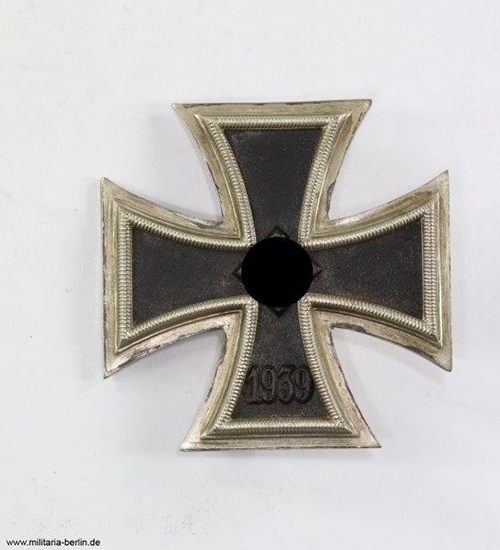
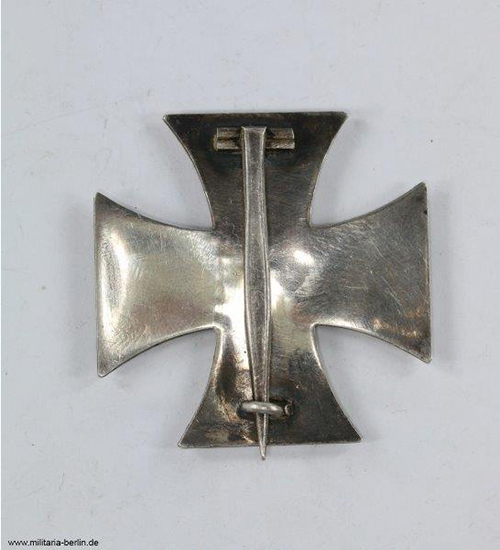
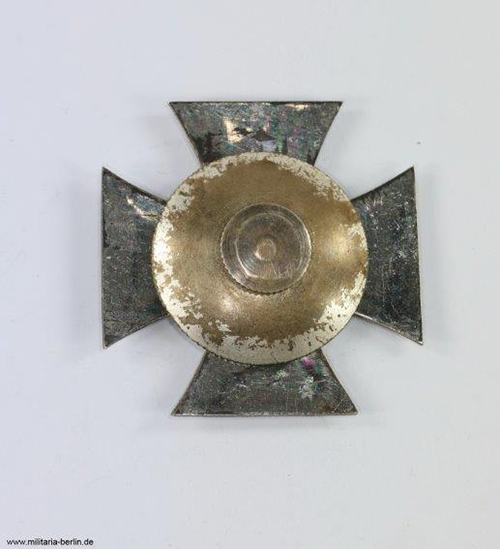
Since the Iron Cross 1st Class is a pin-on badge, there is a pin, screw disc, or other attachment method on the back. Unlike the 2nd Class, there is no ribbon eyelet. On the obverse is a black cross with a paw print. Usually made of blackened iron, but also of non-ferrous metal or zinc. Set in a silver frame. The inner half of the frame is finely ribbed, the outer edges smooth and polished. The frame is usually made of silver-plated non-ferrous metal, but also of real silver. It often develops a strong patina over the years. The reverse, unlike the 2nd Class, has no further design. It is usually just a simple silver back plate.
On the 6 o'clock arm of the front, the respective year of foundation is inscribed: "1870," "1914," or "1939." The crosses of the first foundation, in 1813, have no date at all.
In the middle of the cross are the monograms of the respective monarch: in 1870 the "W" for King Wilhelm of Prussia, in 1914 the "W" for the German Emperor Wilhelm II. The first foundation from 1813 again has no marking, the foundation from 1939 has no monogram, instead a swastika in this place.
On the 12-arm of the foundations of 1870 and 1914 there is a crown, on the foundations of 1813 and 1939 there are no further decorations.
Wearing the Iron Cross 1st Class
The Iron Cross 1st Class was worn as a pin badge on the left chest. If other pin badges were worn, they had to be worn underneath the Iron Cross 1st Class. Since wearing the actual award in the field was often impractical under combat conditions, special cloth versions of the Iron Cross 1st Class were manufactured during both World Wars. These were permitted to be worn under certain conditions.
Award figures for the Iron Cross 1st Class
In the wars of 1813 and 1870/71, the Iron Cross 1st Class was awarded very sparingly. Only approximately 650 were awarded in 1813, and approximately 1.300 in 1870/71. In World War I, a similarly sparing approach was followed at the beginning, but this changed as the war progressed, so that ultimately approximately 150.000 were awarded. In the first year of the war, 1914, only approximately 3.500 were awarded, and in the last year, 1918, approximately 23.000.
World War II saw a similar development to World War I. While efforts were initially made to maintain high standards for awarding awards, this was no longer sustainable as the war progressed due to its duration and increasing severity. During World War II, approximately 470.000 Iron Crosses, First Class, were ultimately awarded. Of these, approximately 145.000 were First Class Repeat Bars, awarded to World War I veterans who had already been awarded the Iron Cross, First Class.
The test pilot Hanna Reitsch was the only recipient of the Iron Cross 1st Class, awarded on November 5, 1942.
Value and purchase of an Iron Cross 1st Class
Due to the large variety of different variants and the long award period, a value can only be determined individually. Crosses from World War I and II generally fetch around €100, although exceptions can fetch €1.000 or more. Older crosses generally fetch well over €1.000. Early pieces from 1813 can fetch €10.000 or more. Documents, cases, and photos of the wearer are also of interest to collectors.