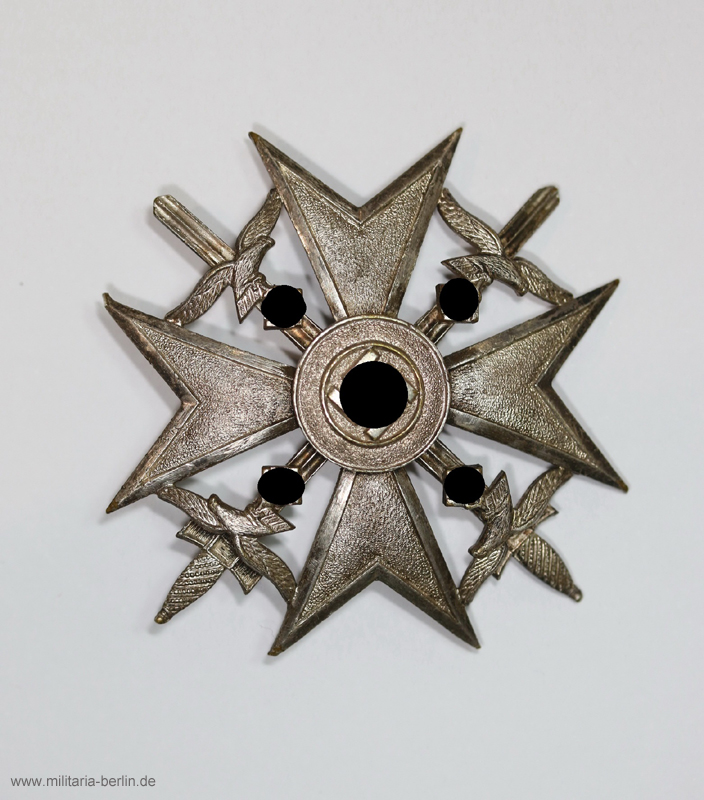
The German Spanish Cross
The Spanish Cross was established by Adolf Hitler on April 14, 1939, for the German volunteers who fought in the Spanish Civil War. It thus represents the first military award of the Third Reich.
The classes of the Spanish Cross
The Spanish Cross was established in three classes and one special class. The three basic classes were the Spanish Cross in Bronze, the Spanish Cross in Silver, and the Spanish Cross in Gold. All classes could be awarded with or without swords. The special class was the Spanish Cross in Gold with Diamonds.
The shape of the Spanish Cross
A Maltese Cross, bronze, silver, or gold depending on the grade. An eagle with a swastika is placed in the angles of the cross. A central medallion with a swastika is applied. The Spanish Cross, awarded with swords, also features crossed swords running through the center. The special grade, in gold with diamonds, has an additional ring around the medallion, bearing 14 diamonds.
Prerequisite for the award of the Spanish Cross
The exact regulations for the various levels are quite complicated; to put it simply, the Spanish Cross could generally be awarded to all German volunteers in the Spanish Civil War.
For the Cross in Bronze with Swords for all volunteers who participated in active combat operations, at least indirectly, e.g. crews of warships and aircraft, without essential function or special merits.
The Bronze Cross without swords is awarded to volunteers or persons of equivalent status who have served in Spain for at least three months without being involved in combat.
For the Silver Cross, in addition to the requirements for the Bronze level, direct enemy contact was also required. This applied to both the Spanish Cross with and without swords.
For the Gold Cross, in addition to the requirements for the Silver level, it was necessary to distinguish oneself through special boldness, courage and bravery.
For the special level in gold with swords and diamonds, the recipients had to have distinguished themselves from other people through outstanding and exemplary deeds.
Wearing the Spanish Cross
The Spanish Cross was worn as a pin-on cross on the right breast. The Iron Cross on the left breast. If the wearer also held a German Cross , the Spanish Cross was worn directly below the German Cross.
Award figures for the Spanish Cross
In total, the Spanish Cross in all its grades, with or without swords, was awarded exactly 26.116 times. This number is divided into Bronze without swords, 7.869 awards, Bronze with swords, 8.462 awards,
Silver without swords, 327 awards, silver with swords, 8.304 awards, gold with swords, 1.126 awards and 28 awards of the special grade in gold with diamonds.
Well-known recipients of the Spanish Cross in Gold with Diamonds included the flying aces Adolf Galland and Werner Mölders, as well as the later Field Marshal Hugo Sperle.
Value and purchase of a Spanish Cross
Due to the sheer number of different variants, a value can only be determined individually. Large estates, including documents, photos, etc., can sometimes be worth well over €10.000. However, individual crosses or documents are also very interesting for collectors and command a correspondingly high price.