The Golden Military Merit Cross
The Golden Military Merit Cross evolved from the Prussian Military Decoration of Honor, established in 1793 by King Frederick William II of Prussia, and was the highest military award for enlisted men and non-commissioned officers that the Kingdom of Prussia could bestow until 1918. It is also called the "Enlisted Men's Pour le Mérite," in analogy to the Pour le Mérite order for officers. It was established on February 27, 1864, by King William I of Prussia.
Who was awarded the Golden Military Merit Cross?
The Gold Military Merit Cross was awarded to all, not only Prussian or German enlisted men and non-commissioned officers, who had distinguished themselves on the battlefield.
The first awards were made in 1866 to 16 non-commissioned officers and men who had distinguished themselves through particular bravery during the war against Austria.
Further awards followed from 1873 to 1884 to 34 members of the Russian Guard who had distinguished themselves in the Russo-Turkish War and in the suppression of the Boxer Rebellion in China. This was followed by four awards to members of the German Schutztruppe from 1895 to 1906, and in 1900 to a member of the Marine Battalion.
During World War I, the award was presented to German soldiers only 1.760 times. The first was awarded on October 15, 1916, to Sergeant Georg Dülz, and the last was awarded on November 3, 1918, to Sergeant Karl Beck. Posthumous awards were possible.
The last recipient was Lieutenant Karl Heinzmann of the Landwehr, who died on April 24, 1990, at the age of 101. He was awarded the Golden Military Merit Cross on May 18, 1918, as deputy officer in the Field Artillery Regiment No. 50 (Baden).
Design of the Golden Military Merit Cross
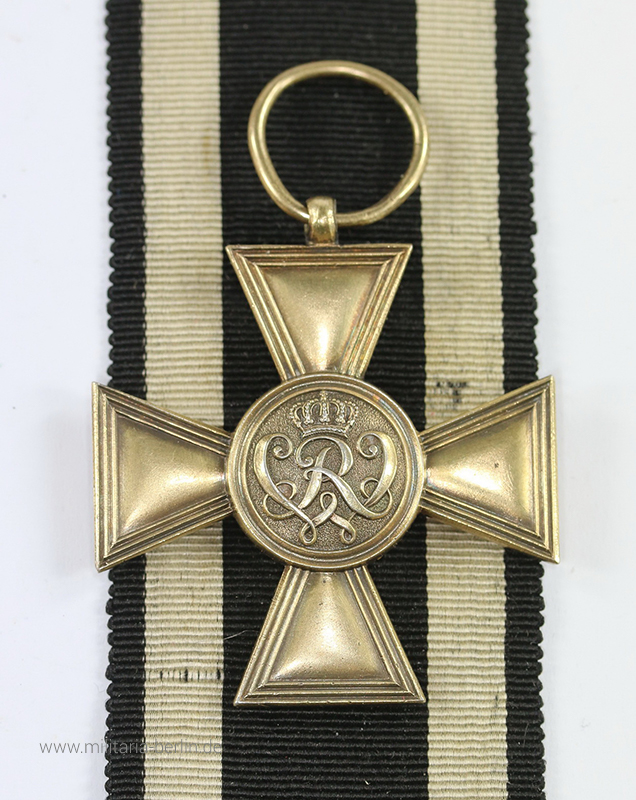
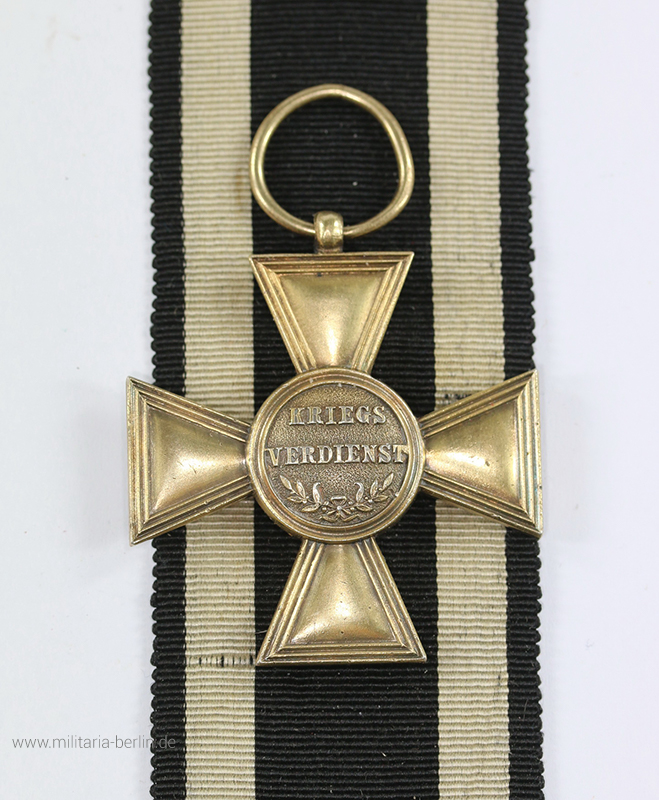
The first crosses were made of gold. During World War I, they were replaced by crosses made of gilded silver (938). The medallion features the founder's initial, "WR," for William Rex (Latin for king), surmounted by a crown. On the reverse is the inscription "War Merit" and below it two small laurel and oak branches.
Wearing the Golden Military Merit Cross
The decoration was worn on a black ribbon with white side stripes (the Prussian colors). The ribbon's colors and layout were identical to that of the Iron Cross 1914, or to that of the House Order of Hohenzollern , only slightly wider.
Special features of the Golden Military Merit Cross
The award was accompanied by a monthly honorary salary of three thalers, later 9 or 20 Reichsmarks, and in the Federal Republic of Germany 25 or, from 1986, 50 DM. Initially, the honorary salary represented a tangible material benefit. In the Federal Republic, it assumed only symbolic significance.
As a further special feature, the bearers had to be greeted with the presentation grip and were entitled to a military funeral parade after their death.
Value and purchase of a Golden Military Merit Cross
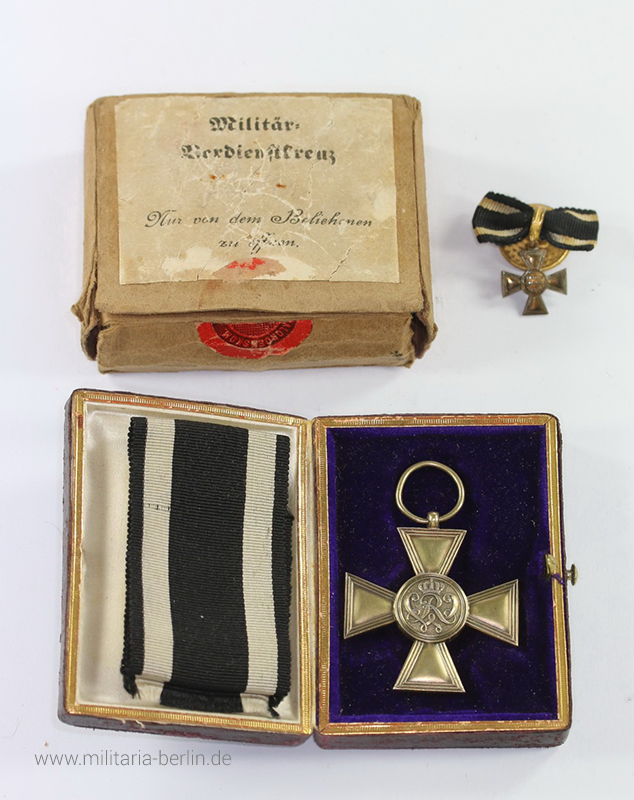
Due to the long award period and the various variants, a value can only be determined individually. Large estates, including certificates, photos, etc., can sometimes be worth well over €10.000. However, individual crosses, certificates, cases, and boxes are also very interesting for collectors and command a correspondingly high price.